When you undergo liposuction, the removed adipose tissue is typically treated as surgical waste and discarded. However, when arrangements are made before the procedure, eligible tissue may instead be collected, transported to a laboratory, processed, cryopreserved, and stored.
This process is often described as liposuction fat tissue storage, adipose tissue cell banking, or storing cells recovered from liposuction.
Concierge Cells coordinates this process with patients and participating medical providers. Instead of losing access to the tissue after surgery, you may be able to preserve cellular material recovered from it for potential future use.
Cell banking does not guarantee that the stored material will qualify for a future treatment, clinical trial, or medical application. Its purpose is to preserve access to your own biological material while cell-based research and technology continue to develop.
What happens to fat removed during liposuction?
Liposuction removes adipose tissue from selected areas of the body through a surgical suction procedure. Unless another arrangement has been made, the removed material is generally discarded after the procedure.
Adipose tissue is more complex than body fat alone. In addition to mature fat cells, it contains connective tissue, blood vessels, immune cells, stromal cells, and other cellular components. Researchers have studied the stromal portion of adipose tissue as a source of adipose-derived cells for tissue engineering and regenerative-medicine research.
Preserving material from liposuction requires advance planning. The patient, surgeon, surgical facility, transportation team, and processing laboratory must all be prepared before the procedure occurs.
Once the tissue has been discarded, it cannot be recovered later.
What is liposuction fat tissue storage?
Liposuction fat tissue storage is a coordinated service that preserves eligible biological material collected during a planned liposuction procedure.
Depending on the program and laboratory process, this may involve:
- Coordinating with the patient and medical provider before surgery
- Collecting eligible adipose tissue during the procedure
- Packaging and transporting the material to a laboratory
- Processing the tissue to recover suitable cellular material
- Preparing the recovered cells for freezing
- Cryopreserving and storing the material under controlled conditions
This process must begin before surgery. Attempting to arrange collection after the procedure has already taken place is generally too late.
Concierge Cells works with patients and participating providers to coordinate the process from initial planning through laboratory storage.
What is adipose tissue cell banking?
Adipose tissue cell banking means preserving cells recovered from adipose tissue for possible future access.
It is important to distinguish cell banking from simply freezing a container of whole fat tissue. A cell-banking process may involve laboratory preparation, isolation of selected cellular material, cryoprotective preparation, controlled freezing, sample identification, and long-term storage.
The precise composition and quantity of the recovered material will vary from one specimen to another. Factors may include:
- The amount and condition of tissue collected
- The collection method
- Time between collection and processing
- Transportation conditions
- Laboratory-processing procedures
- Individual biological variation
Research continues into the best methods for preserving whole adipose tissue, stromal vascular fraction, and cultured adipose-derived cells. Studies have also found that cryopreservation methods can influence cell viability, characteristics, and function, which is why laboratory procedures and quality controls matter.
Can you store stem cells from liposuction?
This is a common question, but the answer requires careful wording.
Adipose tissue contains stromal cells, including cell populations commonly described in research as adipose-derived stromal or stem cells. These cells can be recovered from lipoaspirate through laboratory processing.
However, that does not mean every liposuction sample will produce a guaranteed number of stem cells or a treatment-ready product.
The amount, composition, quality, and future suitability of the recovered material can vary. The term “stem-cell storage” should therefore not be interpreted as a promise that the specimen can later be used to treat a particular disease.
A more accurate description is:
Eligible cells recovered from adipose tissue collected during liposuction may be processed, cryopreserved, and stored for potential future access.
Any future use would depend on the stored material, the intended application, available medical technology, regulatory requirements, and the judgment of qualified healthcare professionals.
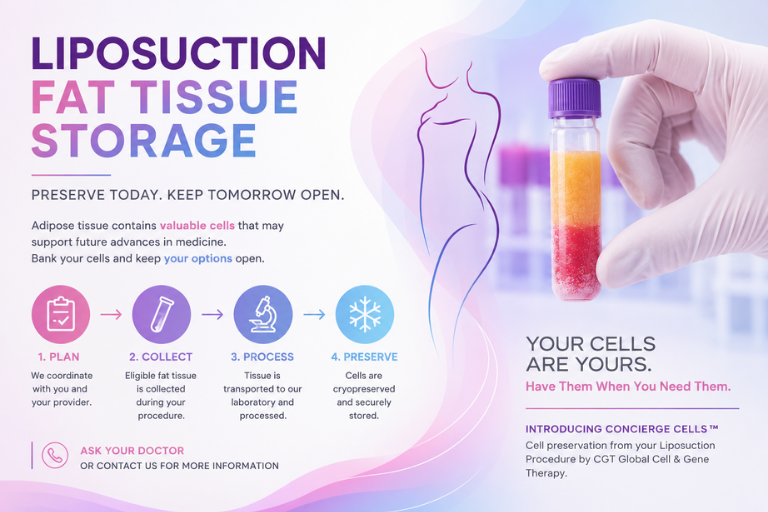
How the Concierge Cells process works
1. Plan before your procedure
Contact Concierge Cells as early as possible before your scheduled liposuction procedure.
Our team reviews basic information such as:
- Your procedure date
- Your surgeon or clinic
- The surgical location
- The type of procedure
- Provider participation
- Transportation and processing logistics
Early planning is important because the collection process must be coordinated with the medical provider and surgical facility in advance.
2. Collect eligible tissue
During the liposuction procedure, eligible adipose tissue that might otherwise be discarded is set aside for preservation.
Your surgeon remains responsible for the procedure and all medical decisions. Concierge Cells does not direct or modify your medical care.
Collection depends on provider participation, facility policies, timing, the procedure performed, and the condition of the recovered tissue.
3. Transport and process the material
After collection, the material is packaged and transported to the CGT Global laboratory.
At the laboratory, trained personnel process the tissue and prepare suitable cellular material for preservation. The resulting cell yield and composition may vary based on the specimen and processing outcome.
Laboratory processing is not a medical diagnosis or treatment. Its purpose is to prepare eligible material for cryopreservation and storage.
4. Cryopreserve and store the cells
The prepared material is frozen using controlled cryopreservation procedures and placed into long-term storage.
Cryopreservation uses very low temperatures to slow biological activity and preserve cellular material. Scientific literature supports cryopreservation as a method for maintaining adipose-derived cells, although preservation methods and outcomes vary.
Stored material remains subject to the terms of the storage agreement, specimen condition, fees, regulatory requirements, and future release procedures.
Why consider cell banking during liposuction?
A planned liposuction procedure creates a unique opportunity to collect adipose tissue without scheduling a separate collection procedure solely for banking.
Potential reasons to consider preservation include:
The tissue may otherwise be discarded
Without an advance preservation arrangement, the tissue is generally unavailable after the procedure.
Future collection may require another procedure
Preserving material now may reduce the need to undergo another tissue-collection procedure solely to obtain adipose tissue later.
The material comes from your own body
Autologous material is biological material collected from and associated with the same individual. Whether it could be used in the future would still depend on the specific application and applicable medical and regulatory requirements.
Cell-based research is continuing to develop
Researchers continue to investigate adipose-derived cells in areas such as tissue engineering, wound repair, musculoskeletal research, and regenerative medicine. These research areas should not be confused with established, approved treatments.
Preservation keeps an option available
Banking does not create a guaranteed medical benefit. It preserves access to biological material that would otherwise be lost.
What could stored cells be used for in the future?
It is not possible to promise exactly how or whether stored cells will be used.
Researchers are studying adipose-derived cells for potential applications in tissue engineering, regenerative medicine, and other cell-based technologies. The field continues to evolve, but research potential is not the same as an approved therapy.
In the United States, the FDA regulates human cells and tissues intended for implantation, transplantation, infusion, or transfer into a recipient. Depending on how a product is processed and intended to be used, different regulatory requirements may apply.
The FDA also states that the only stem-cell products currently approved in the United States consist of blood-forming stem cells derived from umbilical cord blood for certain disorders involving blood production. Adipose-derived stem-cell products are not approved as routine treatments for other diseases or conditions.
Future access to a stored specimen could depend on:
- The quantity and quality of the preserved material
- The type of cells stored
- The intended application
- Scientific and medical developments
- FDA and other regulatory requirements
- Eligibility for an approved treatment or clinical study
- Decisions made by qualified healthcare professionals
Preserving cells today does not guarantee that an approved use will become available later.
What adipose tissue cell banking does not guarantee
Cell banking does not guarantee:
- A specific number or type of recovered cells
- That the sample will meet the requirements of a future application
- Eligibility for a clinical trial
- Access to an experimental therapy
- FDA approval of a future treatment
- That a physician will recommend using the stored material
- Prevention, treatment, or cure of any disease
- That the stored cells will ever be used
Be cautious of any company claiming that banked adipose-derived cells currently cure a broad range of conditions. The FDA has repeatedly warned consumers about unapproved regenerative-medicine products marketed without sufficient evidence of safety or effectiveness.
Questions to ask before storing tissue from liposuction
Before selecting a preservation service, ask:
- How far in advance must I enroll?
- Does my surgeon need to approve participation?
- Can my surgical facility support the collection?
- What biological material will be stored?
- Where will the tissue be processed?
- How will my specimen be identified and tracked?
- What happens if the tissue cannot be processed?
- What are the initial processing and ongoing storage fees?
- How long is the storage agreement?
- How could the specimen be released in the future?
- What happens if I stop paying storage fees?
- What medical or regulatory claims is the company making?
You should receive clear answers before the procedure takes place.
When should you contact Concierge Cells?
Contact Concierge Cells as early as possible after scheduling your liposuction procedure.
Last-minute coordination may not be possible. Our team needs time to review your procedure information, communicate with the medical provider, prepare collection materials, and arrange transportation to the laboratory.
Starting early does not guarantee that collection can be completed, but it gives everyone involved enough time to determine whether the procedure can be supported.
Preserve today. Keep tomorrow open.
Liposuction fat tissue storage allows eligible biological material to be preserved instead of discarded after surgery.
Through advance coordination, laboratory processing, cryopreservation, and storage, Concierge Cells helps patients retain access to cells recovered from their own adipose tissue.
There is no guarantee that the material will qualify for a future medical use. Preservation simply keeps an option available that would otherwise be lost.
Planning a liposuction procedure?
Contact Concierge Cells before your procedure so our team can review the timing, location, provider information, and next steps.
Medical and regulatory disclaimer
Concierge Cells provides collection coordination, laboratory processing, cryopreservation, and storage services. Concierge Cells does not provide medical treatment, medical advice, or a guarantee of future clinical use. Stored material may never be suitable for a treatment, clinical trial, research application, or other medical purpose. Speak with your physician about your procedure and medical decisions.